Below is a list of things I want to accomplish this summer...I'm thinking I may have bit off more than I can chew.
1) Determine which math videos I have still work with the CCSS, then create the videos I need to fill in the gaps. I'd LOVE it if I could start school and have all the videos made for the first 3-4 units.
2) Teach my son how to play Rummy. I love playing cards with the family :)
3) Create/Find explorations to go with as many CCSS as possible. I'm going to need some help here, and I plan on relying heavily on my tweeps (@lisahighfill, help a girl out!)
4) Sit by the pool...and read random Juvenile Fiction books, b/c that's how I roll.
5) Plan a "Celebration of Learning" that makes cross-curricular learning a priority. I'm basing this off an idea from Todd Nesloney about a "Math Fair" instead of a "Science Fair".
6) Read Teach Like a Pirate and Energy Bus. TLaP has been recommended by lots of people I respect, and EB was recently recommended by a good friend (thanks Julie Hughes)...I need to mix in some educational reading along with my not-so educational reading.
7) Think about/plan/organize a Flipped Classroom Writing Project. This idea arose from last night's #flipclass chat. A lot of people were talking about their students blogging, which isn't uncommon. What I found most intriguing was that most of the teachers were NOT English teachers. Science, math, etc. were the norm. I got to thinking, wouldn't it been cool if we could connect classes of different content areas and different grade levels...Wouldn't that be an authentic audience? I still have lots of ideas in my head about this one...stay tuned!
8) Play with my kids. Even though this is number 8 on my list, it's number 1 in priority...I've gotta play with my kids more, while they still want to play with me!
9) Figure out exactly how I'm going to weave writing into math on a more consistent basis...my grade level partner and I are expanding our math & sci/ss time to include our writing and I want to make sure I use it effectively. This might tie into #7 on my list.
10) Pick up my tennis racquet again and actually get out and play (it's been too long).
I'm fairly certain I left something (or somethings) out, and I'll probably end up coming back to this list as the summer gets rolling, but I wanted to write it all down so I don't forget about all the ideas I never have time to do during the school year, but just might have time to do in the summer...you know, when teacher's are on "vacation" and don't do any work.
Tuesday, June 11, 2013

Monday, June 10, 2013
Genius Hour (part 2)
After deciding on topics for Genius Hour, it was time to start getting down to the nitty gritty. As I mentioned before, I decided to attempt Genius Hour in May...not normally a time you'd want to try something new, but I am so glad I did. My students spent the first couple weeks researching and planning out what they wanted to do. They were so engaged! I think I might have had to redirect 1 or 2 students...that's it!
From there we spent the next few weeks prepping for our presentations. Most of the students presentations were simply showing off their knowledge. Here is where I ran into my first couple if issues...
Issue #1 - Be very clear about your expectations with your students. If they aren't supposed to be walking around the school asking other teachers for supplies (which seems common sense, right), then be sure to tell them. Learned that the hard way. Your kids are going to be excited...really excited...but not all the adults in the building want to hear about it, especially if they're interrupting their teaching.
Issue #2 - If your student's want to build something that might be considered a weapon, you should probably get the principal's permission...oops. I didn't think a pen bow & arrow would be a problem, but I guess I was wrong.
Issue #3 - Genius Hour is messy, so be prepared to need 10 minutes at the end for clean up, otherwise you might get an email from your administrator wondering what you're doing, and why it's such a mess. Yup, learned that one the hard way too.
I've worked through all these issues, and NONE of them would stop me from doing it again. My recommendation is to be prepared...really prepared...and prep anyone and everyone who your students might be in contact with about Genius Hour & what it's all about.
And now for the exciting post...the results. My next post will be all about how the presentations/projects turned out. You can find it here.
From there we spent the next few weeks prepping for our presentations. Most of the students presentations were simply showing off their knowledge. Here is where I ran into my first couple if issues...
Issue #1 - Be very clear about your expectations with your students. If they aren't supposed to be walking around the school asking other teachers for supplies (which seems common sense, right), then be sure to tell them. Learned that the hard way. Your kids are going to be excited...really excited...but not all the adults in the building want to hear about it, especially if they're interrupting their teaching.
Issue #2 - If your student's want to build something that might be considered a weapon, you should probably get the principal's permission...oops. I didn't think a pen bow & arrow would be a problem, but I guess I was wrong.
Issue #3 - Genius Hour is messy, so be prepared to need 10 minutes at the end for clean up, otherwise you might get an email from your administrator wondering what you're doing, and why it's such a mess. Yup, learned that one the hard way too.
I've worked through all these issues, and NONE of them would stop me from doing it again. My recommendation is to be prepared...really prepared...and prep anyone and everyone who your students might be in contact with about Genius Hour & what it's all about.
And now for the exciting post...the results. My next post will be all about how the presentations/projects turned out. You can find it here.
Genius Hour (Part 1)
A few months ago one of my twitter buddies Karl Lindgren-Streicher (@LS_Karl) had an Innovation Day at his school. The sheer excitement from his tweets was infectious and I knew I wanted to try it out. If you want to read more about how he ran his Innovation Day, check it out here. Innovation Day, in a nutshell, is a day where the kids come to school, but don't go to any of their regularly scheduled classes. Instead they come to school knowing that throughout the course of the day they will be learning, creating and sharing something that THEY want to learn about. Unfortunately, I didn't catch wind of this until May, and that there was NO WAY I could get something like Innovation Day together before the end of the year.
So I decided to do a little research and I came across Genius Hour. Genius Hour (at least to me) is like a mini-version of Innovation Day. The students get a small chunk of time each week to learn about something they want to learn about. Seeing as I had finished my writing curriculum, I thought that might be a good fit for our writing time for the last month of school...and boy was I right!
I started Genius Hour by showing the YouTube Video "A Pep Talk from Kid President". After that I put up Angela Maiers quote, "You are a genius, and the world needs your contribution." We discussed what it meant, and how passion plays a role in their education. I could see the kids doubting me already...
Then I put up 4 giant pieces of paper with the headings:
- I want to learn about how to...
- I want to learn about why....
- I want to learn to...
- I want to learn to solve...
Then the kids put up sticky notes under each one. Already I could tell this was going to be quite an experience because they were coming up with some amazing ideas. I was also a little nervous because I knew I couldn't help them with a lot of their ideas...I certainly couldn't teach someone how to create a mod on the computer. But that was part of the excitement...they had to figure it out on their own!
The next step was picking one thing...one thing they wanted to spend the next 4 weeks learning about. Below I have some of the topics:
- I want to learn to play the guitar
- I want to learn how to sew a blanket
- I want to learn how to build a dollhouse
- I want to learn how to make a mod on Minecraft
- I want to learn how to bake a chocolate cake
- I want to learn more about the history of the Bengals
- I want to learn how to build a pen bow & arrow
- I want to learn about prehistoric sea creatures
- I want to learn how to make crayon art
- I want to learn how to whittle wood
- I want to learn how to make a volcano
- I want to learn how to air brush
- I want to learn how to make a pineapple upside down cake
- I want to learn how to become a better catcher
There were more, but that is a pretty good list of what my kids came up with...in my next post I'll talk about everything that happened between the introduction and the actual presentations. You can find my next post here.
So I decided to do a little research and I came across Genius Hour. Genius Hour (at least to me) is like a mini-version of Innovation Day. The students get a small chunk of time each week to learn about something they want to learn about. Seeing as I had finished my writing curriculum, I thought that might be a good fit for our writing time for the last month of school...and boy was I right!
I started Genius Hour by showing the YouTube Video "A Pep Talk from Kid President". After that I put up Angela Maiers quote, "You are a genius, and the world needs your contribution." We discussed what it meant, and how passion plays a role in their education. I could see the kids doubting me already...
Then I put up 4 giant pieces of paper with the headings:
- I want to learn about how to...
- I want to learn about why....
- I want to learn to...
- I want to learn to solve...
Then the kids put up sticky notes under each one. Already I could tell this was going to be quite an experience because they were coming up with some amazing ideas. I was also a little nervous because I knew I couldn't help them with a lot of their ideas...I certainly couldn't teach someone how to create a mod on the computer. But that was part of the excitement...they had to figure it out on their own!
The next step was picking one thing...one thing they wanted to spend the next 4 weeks learning about. Below I have some of the topics:
- I want to learn to play the guitar
- I want to learn how to sew a blanket
- I want to learn how to build a dollhouse
- I want to learn how to make a mod on Minecraft
- I want to learn how to bake a chocolate cake
- I want to learn more about the history of the Bengals
- I want to learn how to build a pen bow & arrow
- I want to learn about prehistoric sea creatures
- I want to learn how to make crayon art
- I want to learn how to whittle wood
- I want to learn how to make a volcano
- I want to learn how to air brush
- I want to learn how to make a pineapple upside down cake
- I want to learn how to become a better catcher
There were more, but that is a pretty good list of what my kids came up with...in my next post I'll talk about everything that happened between the introduction and the actual presentations. You can find my next post here.
Genius Hour (part 3)
I'm simply going to say that our Genius Hour presentations were incredible. The students were extremely proud of their work. Below are some shots from our presentations. In hindsight, I will probably rework our presentation rotations, I felt like they didn't run as smoothly as I had hoped. But that was my problem, not my students.


Crayon Art


Sea Animals

Making a "Mod" on Minecraft

How to Build a Dollhouse

How to Whittle Wood

Drills to be a Better Catcher (she made a whole video on it)

How to Make a Blanket

How to Make a Pen Arrow

Origami Master

History of the Cincinnati Bengals

How to Bake a Chocolate Cake

How to Play the Guitar

How to Make a Catapult

Different Forms of Art

How to Make a Volcano

I tried to compile a bunch of the projects. Here are all the ones I could photograph :)


This was one of the most meaningful things my students accomplished this year. They worked hard, and were very proud. This is definitely a keeper!
Sunday, April 21, 2013
Spreading the Flipclass Love!
It seems like recently I've been asked to participate in a lot of flipped classroom trainings. I don't want to lose track of the different activities I've participated in, so I wanted to write it down. I also haven't had a chance to talk much about them, so I'm going to dedicate this posting to spreading the love (of flipclass, that is). Already this year I've participated in the following trainings:
Flipped Classroom Podcast - Troy Cockrum hosts podcasts on the Flipped Learning Network, and I had the privilege of being his "guest" on the 15th episode. You can listen to it here. You might have to search for my name, or episode 15.
MiFlip - This was the first flipped learning conference for teachers in Michigan. I helped plan this conference with some well known flipped classroom masters: Dan Spencer (@runfardvs), David Prindle (@dprindle), Karl Lindgren-Streicher (@LS_Karl), Doug Ragan (@dragan39), David Fouch (@davidfouch) and Anne Thorp (@athorp). In addition to planning the conference, I also presented a session with Brian Bennett on Flip 101 and a session on Elementary Flipping. I wrote about my take-aways here.
Fire Up - This conference is for student teachers within the Grand Rapids area. Teachers, principals, etc. present at this conference on a variety of topics. I spoke about Flipclass (obviously), to two full sessions. If you are interested in the information I presented during that time, there is a link to it all on the upper right corner of my blog.
Monday night #flipclass chat - I participate in the Monday night #flipclass chat on twitter as often as I an (usually 2-3 times a month). Last week we tried something a little bit different. Rather than the normal chat, we had google hangouts that were broadcast live that were based on content. People could either join us in our Google hangout, or watch the live feed. I got to help run the elementary session, with the help of Todd Nesloney (@techninjatodd) and Lisa Highfill (@lhighfill). I have no idea how many people were actually watching the live feed, but it was really nice to get a chance to talk to Lisa & Todd about what they're doing and and how #flipclass works in their classroom. If you missed the chat, the links to ALL subject areas are posted here.
I have the following trainings coming up, yet this year.
Flipped Learning Network Podcast - I will be part of the team who is doing the "elementary flipping" webinar from the series "The Many Faces of Flipped Learning". We are the last of the series, but all other webinars are archived for your viewing pleasure :) Go here and you will be able to sign up for any content that interests you. I will be one of the hosts, along with Lisa Highfill and Amber Mueller. Our webinar will be hel on May 8th at 4:00 EST.
Flipped Learning Workshop - I was asked to be a member of a panel of educators who will be presenting to a group of administrators on #flipclass. This training will be on May 8th (the same day as my FLN podcast !?!). As far as I can tell it is already sold out, which is a beautiful thing! I look forward to talking to them about how it's working in my classroom, as well as how it has made me a better teacher.
Looking back, I'm pretty amazed at how many opportunities I've had to share what I do. It makes me proud to be a part of something that is so important. Flipclass is so successful because it is a movement started by teachers...not administrators. Administrators are crucial to making it successful by being supportive of something new and innovative, but the power of the flipped classroom comes from the teachers. So I end with this, please share what you're doing in your rooms, we can all learn from each other.
Flipped Classroom Podcast - Troy Cockrum hosts podcasts on the Flipped Learning Network, and I had the privilege of being his "guest" on the 15th episode. You can listen to it here. You might have to search for my name, or episode 15.
MiFlip - This was the first flipped learning conference for teachers in Michigan. I helped plan this conference with some well known flipped classroom masters: Dan Spencer (@runfardvs), David Prindle (@dprindle), Karl Lindgren-Streicher (@LS_Karl), Doug Ragan (@dragan39), David Fouch (@davidfouch) and Anne Thorp (@athorp). In addition to planning the conference, I also presented a session with Brian Bennett on Flip 101 and a session on Elementary Flipping. I wrote about my take-aways here.
Fire Up - This conference is for student teachers within the Grand Rapids area. Teachers, principals, etc. present at this conference on a variety of topics. I spoke about Flipclass (obviously), to two full sessions. If you are interested in the information I presented during that time, there is a link to it all on the upper right corner of my blog.
Monday night #flipclass chat - I participate in the Monday night #flipclass chat on twitter as often as I an (usually 2-3 times a month). Last week we tried something a little bit different. Rather than the normal chat, we had google hangouts that were broadcast live that were based on content. People could either join us in our Google hangout, or watch the live feed. I got to help run the elementary session, with the help of Todd Nesloney (@techninjatodd) and Lisa Highfill (@lhighfill). I have no idea how many people were actually watching the live feed, but it was really nice to get a chance to talk to Lisa & Todd about what they're doing and and how #flipclass works in their classroom. If you missed the chat, the links to ALL subject areas are posted here.
I have the following trainings coming up, yet this year.
Flipped Learning Network Podcast - I will be part of the team who is doing the "elementary flipping" webinar from the series "The Many Faces of Flipped Learning". We are the last of the series, but all other webinars are archived for your viewing pleasure :) Go here and you will be able to sign up for any content that interests you. I will be one of the hosts, along with Lisa Highfill and Amber Mueller. Our webinar will be hel on May 8th at 4:00 EST.
Flipped Learning Workshop - I was asked to be a member of a panel of educators who will be presenting to a group of administrators on #flipclass. This training will be on May 8th (the same day as my FLN podcast !?!). As far as I can tell it is already sold out, which is a beautiful thing! I look forward to talking to them about how it's working in my classroom, as well as how it has made me a better teacher.
Looking back, I'm pretty amazed at how many opportunities I've had to share what I do. It makes me proud to be a part of something that is so important. Flipclass is so successful because it is a movement started by teachers...not administrators. Administrators are crucial to making it successful by being supportive of something new and innovative, but the power of the flipped classroom comes from the teachers. So I end with this, please share what you're doing in your rooms, we can all learn from each other.
Tuesday, April 9, 2013
Math Circles...an update
So I started our math circles with my class yesterday and I was really excited about how it went. If you missed that post, click here. The kids were engaged when we were talking about the different jobs, and they liked that they all got to pick their jobs. We also got an opportunity to begin the night's homework, so everyone had a head start. I was nervously anticipating the next day when we would be able to put our math circles into action.
Today was that day. We did a very guided type of math circle, where the students all did their responsibilities in their group, but I led them through the discussion steps.
I wanted to share a few really cool things that happened during this time:
1) All students (even the ones who quizzed out of this learning goal) participated in the discussions.
2) Almost all students did their homework.
3) Many of the students had to step up and become a leader, or their group went down the drain...and they did (become leaders, I mean).
4) After the discussions were done, the students got a chance to work on their practice problems.


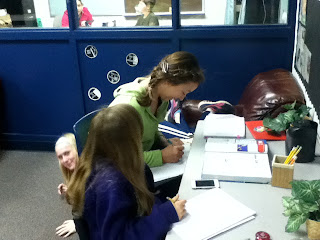

Today was that day. We did a very guided type of math circle, where the students all did their responsibilities in their group, but I led them through the discussion steps.
I wanted to share a few really cool things that happened during this time:
1) All students (even the ones who quizzed out of this learning goal) participated in the discussions.
2) Almost all students did their homework.
3) Many of the students had to step up and become a leader, or their group went down the drain...and they did (become leaders, I mean).
4) After the discussions were done, the students got a chance to work on their practice problems.


Here's where things got really interesting. I had a large amount of students who didn't need to do the practice problems because they already quizzed out of the next unit. I know students do best when you give them choices, so they had a whole bunch of choices.
- Do the back side of the practice problems (review problems)...surprisingly, I did have a few that wanted to do this.
- Make a short example video of how to solve problems that are the same as our learning goal


- Help other students if they were stuck.

I was pleasantly surprised by how many different students chose different things. I will continue to keep you updated on all this as I learn...
On a final note, I also had a student who was absent today. Her group attempted to record their entire discussion because they didn't want her to miss out...unfortunately, they hit stop, not record, and the lesson didn't work :( However, I love the idea, and I'll work with the next group with an absent kid so that we don't have that problem again.
Friday, April 5, 2013
Math Circles...Discussion Groups...Collaboration...You get the idea
 UPDATE (4/9/13): For an update to my math circles, click here.
As you can see by the title of this post I am a bit conflicted on what I want to title my new math project...for now I'm going with Math Circles because the idea stemmed from Literature Circles.
So here was/is my dilemma. I spend the majority of my time during math class having discussions about the videos the students watched the previous night. I do think this is valuable, but I want my students to take more ownership in this part of their learning. That being said, if I just told my 5th graders to go off & start sharing, they would either:
A - look at me like I'm nuts
or
B - head off to discuss many things (very few being math related)
Since I want neither of those things, I needed to find a way to make their group work both meaningful and spelled out for them.
What I came up with was Math Circles. I have had success in the past using Literature Circles in my classroom. Each student had a job, and they held each other accountable. That is exactly what I want for my math kiddos as well, so why not take the idea of Lit. Circles and mold it into something that works for math. After talking to my co-teacher, we came up with the following "jobs" for our math groups:
Discussion Director - Leads the discussion and keeps everyone on track.

Calculator - Makes sure that the groups answers to the questions from the video are actually correct.

Spokesperson - Is the voice of the group. This person summarizes the groups guiding questions (HOT question at the end of the video) and shares them with the teacher.


I have a list of procedures spelled out for the groups.

I plan on beginning this after spring break with the students. I hope they get as excited as I am (although that's unlikely because I'm pretty dang excited about it).
I'm not one to pimp my own stuff, but if you'd like a copy of my Math Circles information, you can get it here.
Subscribe to:
Posts (Atom)